The ceiling line on a multi-site program, and what it costs over fifteen years
You are not buying a ceiling. You are buying the same ceiling in forty locations, finished to one standard, delivered around business hours, on a number you can defend to the person above you.
Restoration is the option that usually gets left out of that conversation, because the quote in front of you is for replacement and nobody has priced the alternative over the life of the asset.
Three options, measured over fifteen years rather than one invoice
The comparison that matters is not what each option costs once. It is what each option costs across the period the portfolio has to look consistent, because two of the three have to be done again inside that window.
| Replace tile and coat the grid | Lasts six to eight years, so it happens about twice in fifteen. Over that period it runs roughly four times the cost of restoring |
|---|---|
| Coat with a general purpose product | Lasts four to six years, so it happens about three times in fifteen. Over that period it runs roughly three times the cost of restoring |
| Restore with ProCoustic | Warranted fifteen years on color retention, so it happens once. On a single application it is generally about half the cost of replacing tile and coating the grid |
Those multiples come from ProCoat’s own life cycle model built on industry benchmark application costs. They are ratios rather than current pricing, because material and labor rates move. Ask for the model run against your actual square footage, your site count and the replacement quote you already hold.
Whether this is a repair or a capital improvement
If the maintenance budget is spent, the question is whether the work can sit on the capital side instead. There is a case that it can, on the grounds that the finish outlasts the finish on a new tile, the light reflectance and surface burning characteristics improve, and the acoustic performance improves, which together put the property in a better condition rather than returning it to the same one.
There is a written summary of that argument, setting out the tests it relies on and the tax decisions it cites, that your finance team can review. It is a starting point for your own advisors rather than advice, and the determination is theirs.
Useful life
A fifteen-year color retention warranty against an average tile life of six to eight years.
Measured improvement
Light reflectance 0.902, against 0.80 for a new white tile. Flame spread 25 to zero. Noise reduction coefficient 0.55 to 0.60. All independently tested.
The documents exist
Laboratory reports, the three-part specification and the capital improvement summary all go to your team on request.
Forty locations that have to match
One tint, recorded
The color is matched and the formulation recorded against your program, so site forty matches site one and a touch-up in year six still matches both.
Whole plane, every time
Tile, grid, air diffusers, return grilles and speaker plates coated together. New tile dropped into an old grid is the look the program is trying to avoid, and a coated tile in an uncoated grid fails the same way.
Worked around business hours
Typically overnight, with the area encapsulated so dust and debris stay inside the work zone. Back in service the next morning.
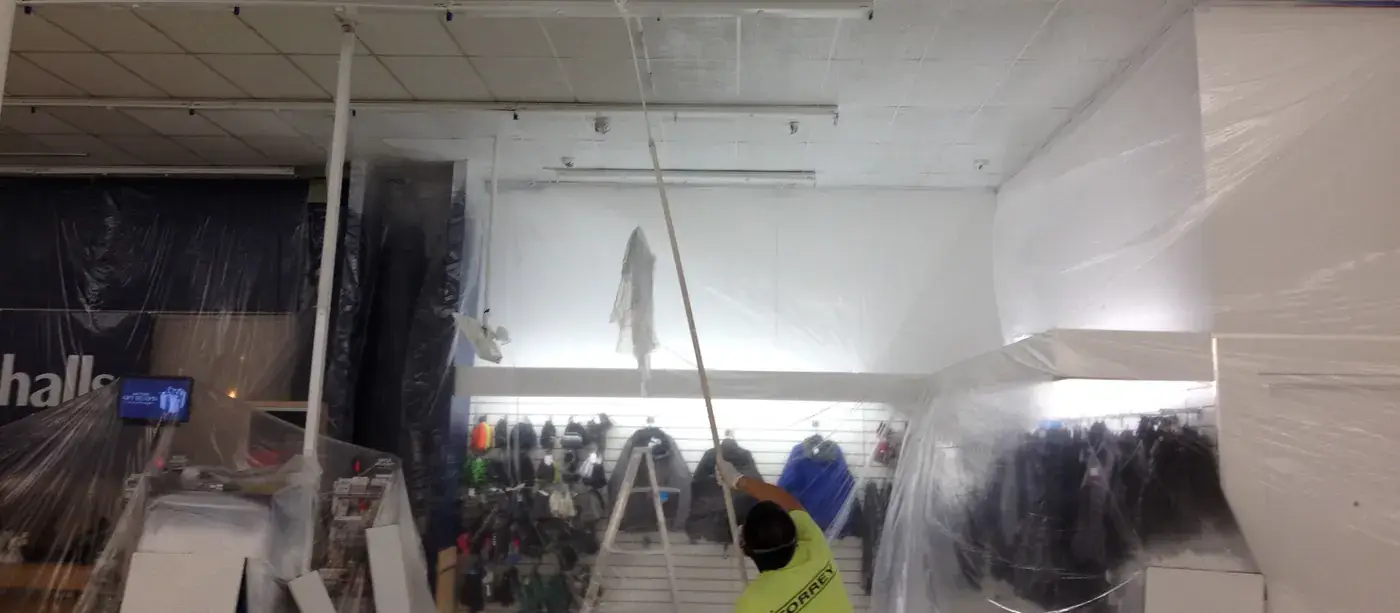
ProCoat does not operate an approved applicator list. Where consistency across sites is the requirement, the work is carried out by ProCoat Contract Services, because the warranty depends on ProCoat having done it and a list would imply a guarantee about work ProCoat did not control.
Forty-one locations, twenty-nine states, seven months
A J.C. Penney program held one specification across forty-one stores in twenty-nine states inside seven months, without closing a store to trade. That is a logistics result rather than a sector result, and it reads across to a convenience chain with four hundred sites as readily as to a department store.
Current programs include a regional grocery group rolling out restored ceilings in a custom color across bakery, deli and produce departments, and a West Coast supermarket chain in the middle of a remodel program now.
What a program needs from you
Site list, square footages, business hours and the standard you want held. ProCoat surveys, and will tell you which sites are candidates and which are not.
What you get back
A survey per site, one specification, one point of responsibility, and a warranty that sits with the company that did the work.
Where it does not apply
Ceilings that are sagging, broken or wet are replacement, not restoration. On one program most sites turned out not to be sound candidates and were told so.
How to put a number on it
Send the replacement quote
The useful comparison is against the number you already hold, on your own square footage, rather than against a benchmark.
Pick one site for a demonstration
Around a hundred square feet, coated, so the standard is agreed on your own building before a program is committed.
Give your finance team the summary
If budget is the constraint rather than the case, the capital improvement question is worth settling early.