The argument
Do not replace it. Do not paint it.
Replacement is expensive and slow. Painting destroys the ceiling you are trying to save. Restoration is the third answer, and it is the one most buildings can afford.
The ceiling is the largest light reflecting surface in the room
In a renovation the walls and the floor get treated and the ceiling gets ignored, which is backwards. The ceiling is the biggest surface you have for spreading light around a room.
The darker it gets, the less light it disperses, and the more the space leans on artificial lighting to do a job the ceiling used to do on its own. A store with new flooring, new fixtures and a twenty year old ceiling looks unfinished for that reason, before anyone looks up and works out why.
That is the argument for dealing with the ceiling at all. What follows is the argument for restoring it rather than replacing it or painting it.
Light
A restored surface disperses light more evenly than the aged one underneath it, because tile, grid and air diffusers are all coated together rather than left as three different colors.
Sound
The perforations stay open, so the ceiling goes on absorbing sound rather than reflecting it back into the room.
Access
Every tile still lifts out, so the void above stays reachable for the data, fire and mechanical services routed through it.
What paint does to an acoustical ceiling
An acoustical tile works because it is full of perforations. Sound goes in and does not come back out. The tile also has to lift, so that the void above it stays reachable.
Just as paint leaves a film that sticks a window to its sill, ordinary paint forms a film across the tile: it fills those perforations and bridges the gap between the tile and the grid. Two things are lost at once: the acoustic absorption the ceiling was specified for, and the ability to lift a tile and reach the services above it. A painted ceiling also usually loses its Class A flame spread rating, which is the part that turns a cosmetic decision into a code problem.
This is the whole of the difference between restoration and damage, and it happens at a joint about a sixteenth of an inch wide that nobody can see from the floor.
Replace, spot replace, or restore
| Replace the tile | Spot replacement | Restore it | |
| Space out of use | Days per area, with demolition and disposal | Hours, but only where tiles are pulled | Usually a single shift, handed back clean |
| Tiles still lift out | Yes, they are new | Yes, but the new tiles will not match | Yes. The coating is formulated not to bridge |
| Sound absorption | As specified, when the right tile is available | Unchanged on the tiles left in place | Improves against the aged ceiling |
| Class A flame spread rating | Per the new tile | Per each tile, old and new | Retained, tested to ASTM International standard E84 |
| Waste to landfills | The whole ceiling | The tiles that are pulled | Only the failed tiles |
| Lead time on material | Yes, and the pattern may be discontinued | Yes, and a match is rarely available | No |
| Doing it again later | Full replacement cost again | The mismatch widens as the ceiling ages | Recoat the same tile |
Restoration is not always the right answer. Where the tile is not a sound candidate for a coating, we will tell you that at the survey.
What replacement costs beyond the invoice
Tile, grid work and labor are the visible cost. The rest is a dumpster at the back door, tile stacked where customers walk, a lead time on a pattern that may have been discontinued, and a space that cannot be used while all of it happens.
In a store, a school or a hotel, that second list is usually larger than the first, and it is the one that never appears on a comparison.
The space, out of use
Days rather than hours, per area, and no way to hand back half of it.
The clear and reset
Fixtures, stock and equipment moved out and moved back, usually by your own people.
The pattern that no longer exists
Matching a discontinued tile across a building, or accepting that the ceiling will read as two ceilings.
What restoration has delivered
What the difference looks like from the floor
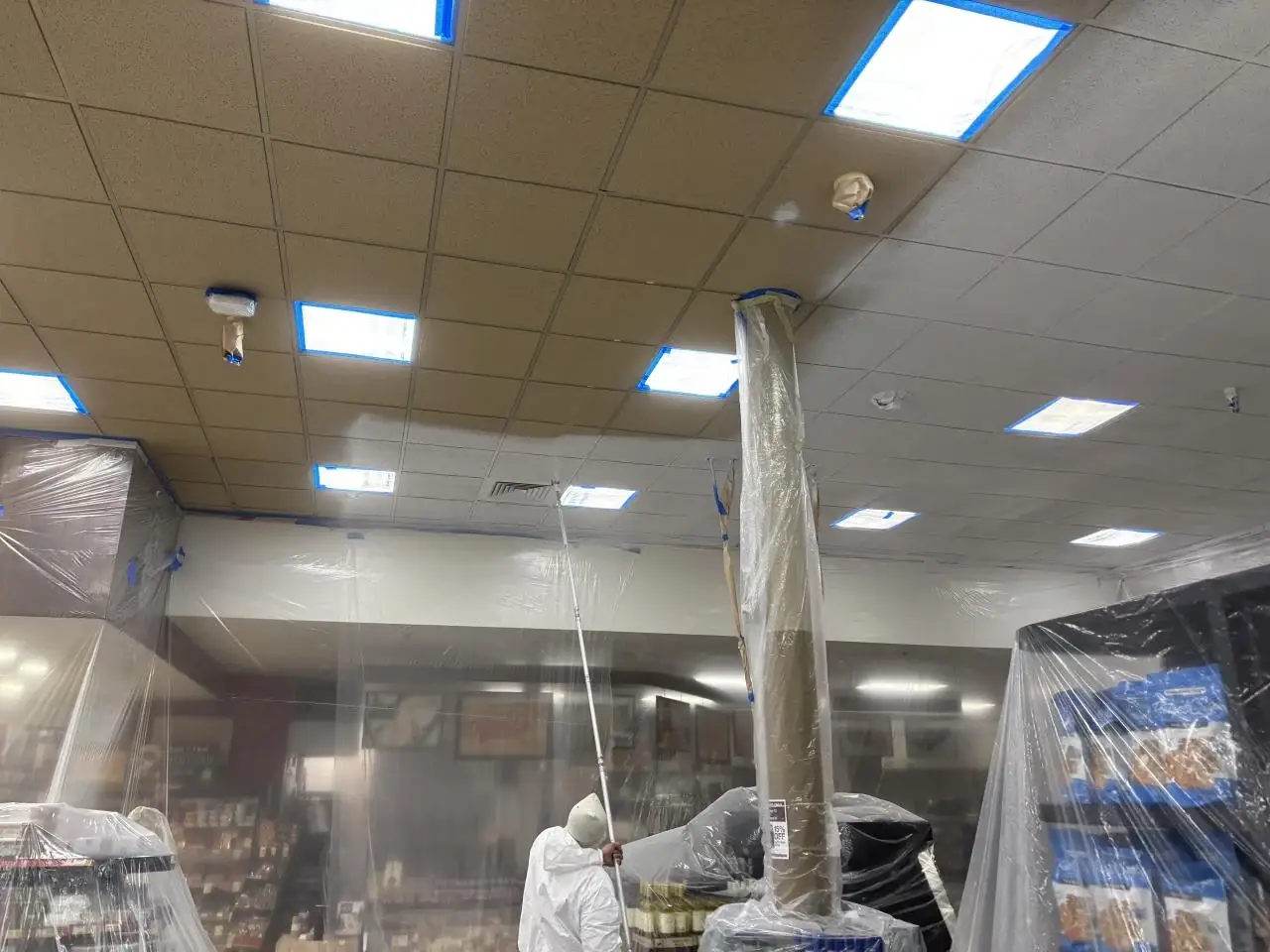
The tile is the same on both sides of this photograph. The right hand side has been coated. The grid and the air diffusers are coated with the tile, which is what stops a restored ceiling looking like new tiles dropped into an old frame.
The part that changes the budget conversation
A restored ceiling can be restored
The second time costs about what the first time cost. There is no point at which the only remaining option is demolition.
A planned interval, not a fight
A line that had to be fought for every fifteen or twenty years turns into an interval that can be planned and budgeted like any other.
The interval is yours to stretch
Touch-up material and the tools to apply it, handed over at completion, are what decide whether the next restoration is in five years or twelve.
Is this just painting the ceiling?
No, and it is worth answering plainly because the two look similar from the floor and behave nothing alike above it. Paint bridges and seals. A ProCoat coating does not.
The Weis Markets store where management asked how the tiles had been replaced in under a week is the clearest evidence of the difference. The existing tile was coated in place, and nobody could tell.
Find out what your ceiling needs
We can do a site survey to tell you whether the ProCoat solution is right for you. If replacement is truly the best solution, we will tell you that as well.
Let’s Talk